Protect Your Retirement Savings With Physical Gold & Silver
With inflation, market volatility, and rising national debt, more Americans are turning to Gold IRAs to safeguard their retirement savings. A Gold IRA is a specialized, Self-Directed Individual Retirement Account (IRA) designed to hold physical gold and silver, and other precious metals. Establishing a Gold IRA can offer several strategic advantages for retirement investors. A Gold IRA may help you:
✓ Protect purchasing power during periods of inflation ✓ Reduce reliance on the U.S. dollar ✓ Add stability during economic downturns ✓ Shield savings from global political and financial turbulence ✓ Diversify with physical, tangible assets ✓ Strengthen long-term control over your retirement strategy
Just like traditional IRAs, a Gold IRA allows pre-tax contributions, meaning that the investment earnings can accumulate tax-deferred. For more information, you can request this Free Investment Kit, which explains everything you need to know about adding physical metals to an IRA.
Best Gold IRA Companies for 2026
Not all Gold IRA companies are created equal. Below is our expert-reviewed comparison of the 8 best Gold IRA companies for 2026, ranked by key factors such as BBB and BCA ratings, verified customer reviews, fee structures, available metals, storage solutions, promotional offers, and buyback policies to help you make a well-informed decision with confidence. Let’s begin by taking a look at our #1 recommendation for Gold IRA company, Birch Gold Group.
🥇1. Birch Gold Group: Best for Gold IRA Specialist
With more than 20 years in business, Birch Gold Group stands out as one of the most established names in the precious metals IRA space. The company maintains an A+ rating with the Better Business Bureau and an AAA rating with the Business Consumer Alliance, alongside thousands of five-star customer reviews.
Birch is known for its education-first approach and straightforward, low-pressure consultation process. Investors appreciate the simplicity of their IRA rollover system and the clarity of their fee structure.
Accounts funded with $50,000 or more qualify for waived setup fees, and cash purchases of $10,000+ receive complimentary shipping. The company also offers a streamlined buyback program, making liquidation simple when needed.
🥈2. GoldenCrest Metals: Best for Transparency & Integrity
Founded in 2024, GoldenCrest Metals has quickly built a reputation for transparent pricing and ethical business practices. Under the leadership of CEO Rich Jacoby, the company emphasizes honesty, client education, and personalized support.
Unlike many competitors, GoldenCrest operates as a boutique firm, offering clients direct access to senior leadership. Their transparent fee model and non-aggressive sales approach have helped them gain strong traction despite being newer to the industry.
The company is BBB-accredited and has earned numerous five-star reviews across verified review platforms.
🥉3. Goldco: Best for Top Customer Service & Rollover Support
Goldco has built its reputation around client support and seamless IRA rollovers. For nearly two decades, the company has helped investors diversify retirement accounts using IRS-approved gold, silver, platinum, and palladium.
What distinguishes Goldco is its hands-on service model — each investor works with a dedicated specialist throughout the rollover process. The company also offers the highest buyback guarantee and strong fee transparency.
Goldco holds an A+ BBB rating and AAA BCA rating and has received industry recognition from thousands of happy customers and multiple official industry awards.
4. Metals Edge: Best for Bullion-Focused Dealer Only
Metals Edge is a full-service precious metals firm dedicated to helping investors protect and grow their wealth through physical gold and silver bullion. Specializing in bullion—not high-premium collectible coins—the company offers precious metals IRAs, secure storage solutions, and direct metal purchases.
Metals Edge has been serving investors since 2007, providing nearly two decades of experience in bullion investing and retirement diversification. The company is Florida licensed, bonded, and insured.
Additionally, Metals Edge holds an A+ BBB rating and has received industry recognition from hundreds of happy customers.
5. Augusta Precious Metals: Best for High-Net-Worth Investors
Augusta Precious Metals caters primarily to higher-net-worth investors seeking premium service and education. The company consistently earns top ratings from watchdog organizations and has received multiple industry awards for trust and overall excellence.
A defining feature is Augusta’s one-on-one educational web conference led by an on-staff Harvard-trained economist. This educational emphasis appeals to investors who want a deeper understanding before committing significant capital.
Augusta’s rollover process is structured and well-supported by experienced IRA specialists.
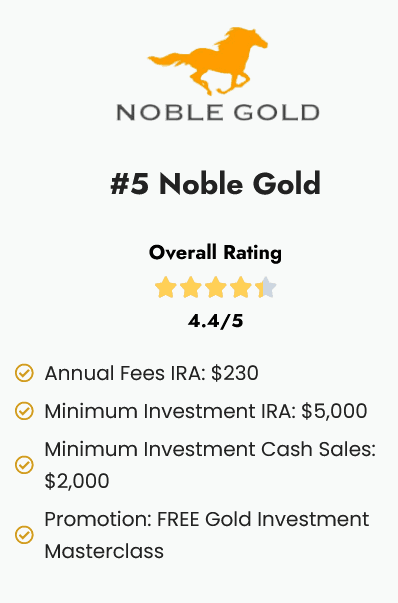
6. Noble Gold Investments: Best for Low Investment Minimums
Established in 2017, Noble Gold Investments offers one of the lowest IRA minimums in the industry. This makes them particularly attractive to first-time precious metals investors.
The company holds an A+ BBB rating and AA BCA rating and has built a solid reputation for personalized service. Noble Gold also offers a broad selection of IRA-eligible bullion products in various denominations, providing flexibility for smaller portfolios.
Their educational resources are designed to help investors build resilient portfolios during economic uncertainty.
7. American Hartford Gold: Best for Good Product Selection
Founded in 2016, American Hartford Gold has processed over $1 billion in transactions. The company is recognized for its wide product assortment and strong customer support model.
With leadership rooted in coin collecting and numismatics, the firm offers an extensive selection of gold and silver bullion and rare coins. Investors benefit from transparent pricing, competitive fee structures, and free IRA rollover assistance.
The company has also been recognized in the Inc. 5000 rankings within the precious metals sector.
8. BullionVault: Best Online Gold & Silver Trading Platform
BullionVault operates differently from traditional Gold IRA companies. As one of the largest online bullion trading platforms globally, it allows investors to buy and store gold, silver, and platinum in secure vaults located in Zurich, London, Toronto, Singapore, and New York.
Although headquartered in the UK and not BBB-rated, BullionVault has served clients for over 20 years and is partially owned by the World Gold Council, offering direct access to the professional bullion market.
This platform is especially well-suited for international investors and active traders who prefer online execution and global storage options.
What Is a Gold IRA or Precious Metals IRA?
A Gold IRA (Gold Individual Retirement Account) is a self-directed retirement account that allows you to hold physical precious metals—such as gold, silver, platinum, and palladium—inside a tax-advantaged IRA structure.
Unlike a traditional IRA that typically holds stocks, bonds, or mutual funds, a Gold IRA allows investors to diversify their retirement portfolio with IRS-approved bullion, bars, and coins that are stored in a secure, regulated depository until you choose to make a withdrawal.
How about taxes? Gold IRAs follow the same tax rules as traditional or Roth IRAs:
✓ Traditional Gold IRA: Contributions may be tax-deductible, and growth is tax-deferred until withdrawal ✓ Roth Gold IRA: Contributions are made with after-tax dollars, and qualified withdrawals may be tax-free
While no investment is without risk, many retirement savers turn to Gold IRAs as a strategic diversification tool. Here are five key reasons why you should consider a Gold IRA for wealth preservation and peace of mind:
1. Hedge Against Inflation
Gold has historically maintained purchasing power during periods of rising inflation. When the value of the U.S. dollar declines, tangible assets like gold often retain relative strength compared to cash-based investments. For retirees on fixed incomes, protecting purchasing power can be a major priority.
2. Diversification Beyond Paper Assets
Traditional retirement accounts are typically heavily weighted toward equities and bonds. A Gold IRA introduces a non-correlated asset class, which may help reduce overall portfolio volatility during periods of market turbulence. Diversification does not eliminate risk, but it can help spread exposure across different economic conditions.
3. Protection During Economic Uncertainty
Gold has historically been viewed as a “safe-haven” asset during:
✓ Rising sovereign debt ✓ Stock market downturns ✓ Banking instability ✓ Currency devaluation ✓ And geopolitical tension
While past performance does not guarantee future results, many investors allocate a portion of retirement savings to precious metals as a defensive strategy.
4. Tangible Asset Ownership
Unlike stocks or ETFs, a Gold IRA allows you to own physical, IRS-approved bullion stored in an insured depository. Some investors value the psychological and strategic benefit of holding a tangible asset rather than solely digital or paper-based holdings. Additionally, a new financial system (QFS) is emerging, which will be backed by precious metals and other commodities instead of paper assets, so holding physical gold and silver might help multiply your wealth.
5. Long-Term Wealth Preservation
Gold is often viewed not as a high-growth asset, but as a wealth preservation vehicle. Its role in a retirement strategy is typically centered on stability and capital protection rather than rapid appreciation. Many financial professionals suggest that precious metals may represent a modest percentage of a well-balanced retirement portfolio, depending on individual goals and risk tolerance.
In 2025, the price of gold experienced a historic increase, rising approximately 60% to 66% over the course of the year. And looking over the last 30 years, the price of gold has increased by approximately 1,235%, rising from around $390 per ounce in early 1996 to roughly$5,212 per ounce in February 2026:
Overall, gold and silver have served as monetary anchors for thousands of years. Unlike fiat currencies, they cannot be created at will, and their supply grows slowly over time.
How Do You Fund a Gold IRA?
Establishing a self-directed Gold IRA is only the first step. The account must be funded in accordance with Internal Revenue Service (IRS) regulations governing qualified retirement plans. Most Gold IRAs are funded through one of the following methods:
1. Direct Trustee-to-Trustee Transfer
A direct transfer occurs when assets move directly from one IRA custodian to another without the account holder taking possession of the funds. This method is generally not treated as a taxable event and is not subject to mandatory withholding. Transfers are commonly used when moving funds from:
✓ Traditional IRAs ✓ Roth IRAs ✓ SEP IRAs ✓ SIMPLE IRAs (subject to applicable holding periods)
Direct transfers are typically considered the most streamlined and lower-risk method from a tax-compliance standpoint.
2. Rollover From an Employer-Sponsored Plan (e.g., 401(k), 403(b), TSP)
Funds from qualified employer-sponsored retirement plans may be rolled into a self-directed IRA, including one that invests in IRS-approved precious metals, provided the distribution qualifies under applicable regulations. Rollover eligibility depends on several factors, including:
✓ Whether the account holder is separated from service ✓ Whether the plan permits in-service distributions ✓ Plan-specific rules and administrative requirements
When a rollover is processed as a direct rollover (funds sent directly to the new custodian), it is generally not subject to mandatory 20% federal withholding. If funds are distributed to the account holder first (an indirect rollover), strict IRS rules apply:
✓ The full amount must be redeposited within 60 days ✓ Only one indirect IRA rollover is permitted per 12-month period (per IRS rules) ✓ Failure to complete the rollover properly may result in income taxes and potential early distribution penalties if under age 59½
Because indirect rollovers carry additional compliance risks, investors should review IRS guidelines carefully before proceeding.
Can You Roll Over a 401(k) Into a Gold IRA?
In many cases, yes — particularly if the 401(k) is from a former employer. If you are still employed, your ability to move funds may be limited by plan restrictions. Some plans allow in-service withdrawals after reaching a certain age; others do not permit rollovers until employment ends. Before initiating any rollover:
✓ Review your Summary Plan Description (SPD) ✓ Confirm eligibility with your plan administrator ✓ Consult a qualified tax professional or financial advisor
Eligibility determinations, tax treatment, and reporting obligations are governed by federal law and individual plan documents.
Where Is Gold Stored in a Gold IRA?
If you open a Gold IRA, the physical gold cannot be stored at home. IRS rules require that precious metals held inside an IRA be kept at an approved third-party depository. These facilities specialize in securely storing gold, silver, and other precious metals on behalf of retirement accounts. That means you cannot keep IRA gold:
✓ In a home safe ✓ In a personal safety deposit box ✓ Or, in a private vault under your control
If you take personal possession of the metals, the IRS may treat it as a taxable distribution, which could result in income taxes and possible penalties.
Who Handles the Storage?
A Gold IRA involves two separate parties:
✓ The Custodian: Handles paperwork, reporting, and compliance with IRS rules ✓ The Depository: Safely stores your physical metals
Most Gold IRA companies work with established, IRS-approved storage facilities. However, in many cases, you can choose a different approved depository if you prefer, as long as it meets regulatory standards and is accepted by your custodian. Some well-known storage providers in the industry include:
✓ Brink’s ✓ Delaware Depository ✓ IDS of Texas
How Secure Are These Facilities?
Approved depositories are designed specifically for storing high-value assets. While features vary by facility, they typically offer:
✓ Purpose-built vaults for precious metals ✓ Advanced security systems and monitoring ✓ Restricted access controls ✓ Comprehensive insurance coverage
You also have the option of segregated storage for $150 per year, where your metals are stored separately in your name, or non-segregated storage for $100 per year, where metals are stored together with others of the same type. Your custodian or Gold IRA company can explain the differences and associated costs.
What About Shipping and Insurance?
When you purchase metals for your Gold IRA, the dealer and custodian typically arrange insured shipment directly to the approved depository. Metals are only shipped to your home for regular purchases outside of an IRA. As always, it’s important to review storage fees, insurance details, and depository policies before funding your account.
What Are the IRA Contribution Limits and Distribution Rules?
Gold IRAs follow the same annual contribution limits as other Traditional and Roth IRAs. For 2026, total contributions across all IRAs cannot exceed $7,500 (or $8,600 for individuals age 50 or older), or your taxable compensation for the year—whichever is lower. Rollover amounts and qualified reservist repayments do not count toward these annual limits.
Traditional IRAs are also subject to Required Minimum Distribution (RMD) rules. Under current federal law, account holders must begin taking minimum withdrawals starting at age 73 (or as otherwise required by applicable law). The amount withdrawn each year is taxable as ordinary income. Roth IRAs generally are not subject to RMDs during the original owner’s lifetime.
Failure to follow contribution limits, distribution timelines, IRS-approved metal requirements, or storage regulations may result in taxes and penalties. Investors should review current IRS guidance or consult a qualified tax professional before making contributions or taking distributions.
⚠️ Important Considerations
Before opening a Gold IRA, investors should understand:
✓ Precious metals must meet IRS purity standards ✓ Metals must be stored in an approved depository ✓ There are custodian and storage fees ✓ Gold and silver prices can fluctuate ✓ Required minimum distributions (RMDs) apply to traditional accounts
A Gold IRA is not suitable for every investor, but it can be a strategic component of a diversified retirement plan when used thoughtfully. A Gold IRA allows retirement savers to hold physical precious metals within a tax-advantaged account structure. For those seeking diversification, inflation protection, and a potential hedge against economic instability, it may serve as a complementary asset alongside traditional investments.
As with any retirement decision, it’s important to consult a qualified financial professional to determine whether a Gold IRA aligns with your long-term goals, risk tolerance, and overall portfolio strategy
📚 Gold IRA FAQ: Frequently Asked Questions About Gold IRAs
How Is a Gold IRA Different From a Traditional IRA?
The primary difference between a Gold IRA and a Traditional IRA is the asset class:
✓ A traditional IRA typically holds stocks, bonds, ETFs, or mutual funds ✓ In contrast, a Gold IRA holds physical precious metals that meet IRS purity standards
Both accounts may offer tax-deferred or tax-free growth depending on whether the account is structured as Traditional or Roth.
Who Should Consider a Gold IRA?
A Gold IRA may be appropriate for investors who:
✓ Want to diversify beyond traditional paper assets ✓ Are concerned about inflation, currency risk, or rising sovereign debt ✓ Seek exposure to tangible assets within a retirement account ✓ Take real ownership of their financial future with a store of value ✓ Diversify their investment portfolio
However, it may not be suitable for those seeking high-growth investments or low-cost index exposure.
Is a Gold IRA Endorsed or Guaranteed by the Government?
No. Gold IRAs are not endorsed, guaranteed, or insured by the U.S. government. While IRAs are governed by federal tax law, the value of precious metals is subject to market fluctuations and may rise or fall over time.
Can a Gold IRA Hold Other Types of Investments?
A Gold IRA is typically structured as a self-directed IRA, which means it may allow a broader range of assets than a standard brokerage IRA—provided the custodian supports those investments and they comply with IRS regulations. Depending on the custodian, a self-directed IRA may permit alternative assets such as:
✓ Private equity investments ✓ Private lending or promissory notes ✓ Real estate ✓ Certain stocks, bonds, or mutual funds ✓ Other IRS-eligible alternative assets
However, not all custodians offer access to every asset class. Investment availability depends on the account structure and the administrative capabilities of the custodian.
What Types of Metals Are Allowed in a Gold IRA?
Only metals that meet IRS fineness standards under Internal Revenue Code Section 408(m) are eligible to be included in an IRA. Generally, these standards are:
✓ Gold must be at least 99.5% pure ✓ Silver must be at least 99.9% pure ✓ Platinum should have a minimum of 0.9995 purity ✓ Palladium should have a minimum of 0.9995 purity
Collectibles and most rare coins do not qualify. Eligibility should always be confirmed with the IRA custodian before purchase.
Can I Store IRA Gold at Home?
No. IRS regulations require that IRA-held metals be stored at an approved third-party depository. Personal possession of IRA metals may be treated as a taxable distribution and could result in penalties.
How Is a Gold IRA Funded?
Gold IRAs may be funded by:
✓ Direct trustee-to-trustee transfer from an existing IRA ✓ Eligible rollover from a 401(k), 403(b), TSP, or similar qualified plan ✓ Or, annual contributions within IRS limits
Indirect rollovers are subject to strict 60-day deadlines and other IRS restrictions. Failure to comply may result in taxes and penalties. Eligibility depends on your specific retirement plan rules and employment status.
Are There Fees Associated With a Gold IRA?
Yes. Investors should expect fees that may include:
Gold IRA Set Up
Pricing
Custodian Administrative Fees
$180-$330 annually
Storage and Insurance Fees
$100-$150 per year
Transaction or Wire Fees
$30-$50 one time fee
Fee structures vary by provider. Investors should review all written disclosures before opening an account.
Is Gold a Safe Investment?
All investments carry risk, including precious metals. Gold prices are influenced by market conditions, interest rates, currency values, supply and demand, and geopolitical events. Past performance is not indicative of future results. Additionally, gold doesn’t generate income such as dividends or interest.
Are There Required Minimum Distributions (RMDs)?
Yes, Traditional Gold IRAs are subject to Required Minimum Distribution rules beginning at the age specified under current federal law. Failure to take required distributions may result in IRS penalties. Roth IRAs are generally not subject to RMDs during the original account holder’s lifetime.
How Liquid Is a Gold IRA?
Precious metals in an IRA can be sold through your custodian, and the proceeds can either remain in the account or be distributed (subject to applicable tax rules). Liquidity depends on market conditions and dealer pricing at the time of sale.
How Much of My Retirement Should Be in Gold?
There is no one-size-fits-all allocation. Some financial professionals suggest that precious metals may represent a modest percentage of a diversified portfolio, depending on risk tolerance, time horizon, and financial objectives. Investors should consult with a licensed advisor before making allocation decisions.
What Are the Tax Implications of a Gold IRA?
Tax treatment depends on the account type:
✓ Traditional Gold IRA: Contributions may be tax-deductible; withdrawals are taxed as ordinary income ✓ Roth Gold IRA: Contributions are made with after-tax dollars; qualified withdrawals may be tax-free
Improper rollovers, early withdrawals (before age 59½), or failure to meet RMD requirements may result in taxes and penalties.
Can I Lose Money in a Gold IRA?
Yes. The value of precious metals may decline. Investors may receive less than their original investment upon liquidation. Market liquidity and dealer spreads may also affect sale proceeds.
Is a Gold IRA Right for Everyone?
No investment strategy is suitable for all investors. A Gold IRA may not be appropriate for individuals seeking short-term gains, income-producing assets, or low-cost passive index exposure. Overall, investors should evaluate:
✓ Overall portfolio allocation ✓ Liquidity needs ✓ Time horizon ✓ Risk tolerance ✓ And tax considerations
Consulting a licensed financial advisor or tax professional is recommended before making retirement allocation decisions.
“Gold IRA Store gave me peace of mind knowing that I chose a trusted Gold IRA company who answered all my questions and held my hand through the setup process. Knowing a portion of my portfolio is backed by physical gold and silver makes me feel more secure about my future.”
Sophie Jones
Minnesota, United States
Get a Free Info Kit on Gold & Silver!
Before you go, request a free info kit on gold and silver and secure your wealth today!